Armstrong Number Calculator: Finally Understand Narcissistic Numbers
Let me tell you about the first time I encountered an Armstrong number. I was reading a math puzzle book, and I saw that 153 = 1³ + 5³ + 3³. I thought, "That's beautiful—the number loves itself so much it equals the sum of its own digits raised to a power."
Then I learned these are called Armstrong numbers (or narcissistic numbers). There are only 88 of them in base 10. The largest has 39 digits. And once you understand the pattern, you'll see why they're so rare.
In this guide, I'll walk you through everything you need to know about Armstrong numbers—from single-digit numbers to the 39-digit behemoth.
Ready to explore Armstrong numbers? Try our Armstrong Number Calculator and discover these self-loving numbers.
What Is an Armstrong Number?
An Armstrong number (also called a narcissistic number or pluperfect digital invariant) is a number that equals the sum of its own digits each raised to the power of the number of digits.
The Formula
For an n-digit number with digits d₁, d₂, ..., dₙ:
d₁ⁿ + d₂ⁿ + ... + dₙⁿ = the number itself
Simple Examples
| Number | Digits | Power | Calculation | Result |
|---|---|---|---|---|
| 1 | 1 | 1¹ | 1¹ = 1 | ✓ Armstrong |
| 2 | 1 | 2¹ | 2¹ = 2 | ✓ Armstrong |
| 3 | 1 | 3¹ | 3¹ = 3 | ✓ Armstrong |
| 4 | 1 | 4¹ | 4¹ = 4 | ✓ Armstrong |
| 5 | 1 | 5¹ | 5¹ = 5 | ✓ Armstrong |
| 6 | 1 | 6¹ | 6¹ = 6 | ✓ Armstrong |
| 7 | 1 | 7¹ | 7¹ = 7 | ✓ Armstrong |
| 8 | 1 | 8¹ | 8¹ = 8 | ✓ Armstrong |
| 9 | 1 | 9¹ | 9¹ = 9 | ✓ Armstrong |
| 10 | 2 | 1² + 0² | 1 + 0 = 1 ≠ 10 | ✗ |
| 153 | 3 | 1³ + 5³ + 3³ | 1 + 125 + 27 = 153 | ✓ Armstrong |
All Armstrong Numbers in Base 10
There are exactly 88 Armstrong numbers in base 10.
1-Digit Armstrong Numbers (0-9)
All single-digit numbers (0-9) are Armstrong numbers because d¹ = d.
2-Digit Armstrong Numbers
None! No two-digit number equals the sum of the squares of its digits.
Check: 10 → 1² + 0² = 1, 11 → 1² + 1² = 2, 12 → 1² + 2² = 5...
3-Digit Armstrong Numbers
| Number | Calculation |
|---|---|
| 153 | 1³ + 5³ + 3³ = 1 + 125 + 27 = 153 |
| 370 | 3³ + 7³ + 0³ = 27 + 343 + 0 = 370 |
| 371 | 3³ + 7³ + 1³ = 27 + 343 + 1 = 371 |
| 407 | 4³ + 0³ + 7³ = 64 + 0 + 343 = 407 |
4-Digit Armstrong Numbers
| Number | Calculation |
|---|---|
| 1634 | 1⁴ + 6⁴ + 3⁴ + 4⁴ = 1 + 1296 + 81 + 256 = 1634 |
| 8208 | 8⁴ + 2⁴ + 0⁴ + 8⁴ = 4096 + 16 + 0 + 4096 = 8208 |
| 9474 | 9⁴ + 4⁴ + 7⁴ + 4⁴ = 6561 + 256 + 2401 + 256 = 9474 |
5-Digit Armstrong Numbers
- 54748
- 92727
- 93084
6-Digit Armstrong Numbers
- 548834
7-Digit Armstrong Numbers
- 1741725
- 4210818
- 9800817
- 9926315
8-Digit Armstrong Numbers
- 24678050
- 24678051
- 88593477
9-Digit Armstrong Numbers
- 146511208
- 472335975
- 534494836
- 912985153
10-Digit Armstrong Number
- 4679307774
The Largest Armstrong Number
The largest Armstrong number has 39 digits:
115,132,219,018,763,992,565,095,597,973,971,522,401
Why Are They Called "Narcissistic"?
The term "narcissistic" comes from Greek mythology—Narcissus fell in love with his own reflection. These numbers are "in love with themselves" because they equal the sum of their own digits raised to powers.
Alternative Names
| Name | Origin |
|---|---|
| Armstrong number | Named after Michael F. Armstrong |
| Narcissistic number | Greek myth reference |
| Pluperfect digital invariant | Mathematical description |
| Plus-perfect number | Alternative term |
Step-by-Step Examples
Example 1: Check if 153 is Armstrong
Step 1: Count digits → 3 digits
Step 2: Calculate each digit raised to power 3
- 1³ = 1 × 1 × 1 = 1
- 5³ = 5 × 5 × 5 = 125
- 3³ = 3 × 3 × 3 = 27
Step 3: Sum the results
- 1 + 125 + 27 = 153
Step 4: Compare to original
- 153 = 153
Result: ✓ 153 is an Armstrong number!
Example 2: Check if 370 is Armstrong
Step 1: 3 digits
Step 2:
- 3³ = 27
- 7³ = 343
- 0³ = 0
Step 3: 27 + 343 + 0 = 370
Result: ✓ 370 is an Armstrong number!
Example 3: Check if 1634 is Armstrong
Step 1: 4 digits
Step 2:
- 1⁴ = 1
- 6⁴ = 6 × 6 × 6 × 6 = 1,296
- 3⁴ = 3 × 3 × 3 × 3 = 81
- 4⁴ = 4 × 4 × 4 × 4 = 256
Step 3: 1 + 1,296 + 81 + 256 = 1,634
Result: ✓ 1634 is an Armstrong number!
Example 4: Check if 123 is Armstrong
Step 1: 3 digits
Step 2:
- 1³ = 1
- 2³ = 8
- 3³ = 27
Step 3: 1 + 8 + 27 = 36
Step 4: 36 ≠ 123
Result: ✗ 123 is NOT an Armstrong number
Properties of Armstrong Numbers
Property 1: Finite in Any Base
For any given base, there are only finitely many narcissistic numbers.
Property 2: All Single Digits Are Armstrong
0-9 are all Armstrong numbers because d¹ = d.
Property 3: No 2-Digit Armstrong Numbers
There are no two-digit narcissistic numbers. Try proving why!
Property 4: Consecutive Armstrong Numbers
370 and 371 are consecutive Armstrong numbers—the only consecutive pair (except single digits).
Property 5: 153 is Special
153 is the smallest 3-digit Armstrong number and appears in the Bible (153 fish in John 21:11).
The Math Behind the Rarity
Why So Few?
For an n-digit number, the maximum possible sum is n × 9ⁿ.
| Digits (n) | Max sum = n × 9ⁿ |
|---|---|
| 1 | 1 × 9 = 9 |
| 2 | 2 × 81 = 162 |
| 3 | 3 × 729 = 2,187 |
| 4 | 4 × 6,561 = 26,244 |
| 5 | 5 × 59,049 = 295,245 |
| 6 | 6 × 531,441 = 3,188,646 |
| 7 | 7 × 4,782,969 = 33,480,783 |
| 8 | 8 × 43,046,721 = 344,373,768 |
| 9 | 9 × 387,420,489 = 3,486,784,401 |
| 10 | 10 × 3,486,784,401 = 34,867,844,010 |
For n=60, 9^60 is astronomically large, but the number of digits grows slower. Eventually, n × 9ⁿ has fewer digits than n, making Armstrong numbers impossible beyond a certain point.
Maximum Digits in Base 10
The maximum possible digits for an Armstrong number in base 10 is 39. That's why only 88 exist!
How to Use Our Armstrong Calculator
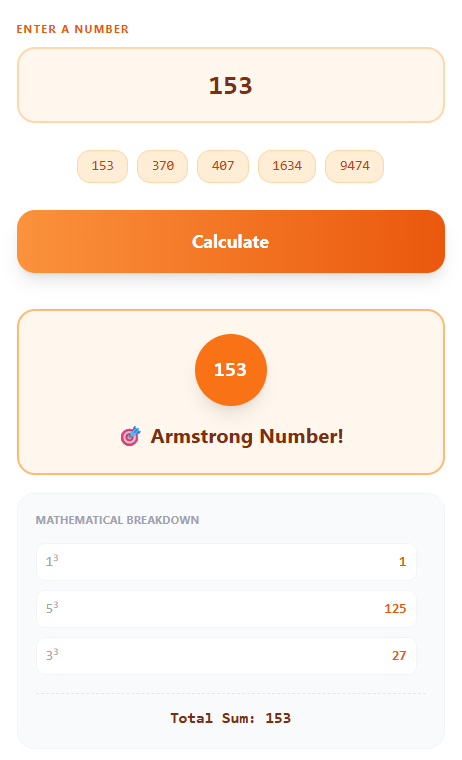
Step 1: Enter a Number
Type any positive integer. Example: 153
Step 2: Click Calculate
The calculator:
- Counts the number of digits
- Raises each digit to the power of digit count
- Sums all results
- Compares sum to original number
Step 3: Read Your Results
You'll see:
- Classification: Armstrong number or not
- Mathematical breakdown: Each digit raised to power
- Sum calculation: Total of all digit powers
- Difference: How far off (if not Armstrong)
Example Buttons
Quick test known Armstrong numbers:
- 153 (3-digit)
- 370 (3-digit)
- 407 (3-digit)
- 1634 (4-digit)
- 9474 (4-digit)
What It Handles
| Input | Example | Result |
|---|---|---|
| 1-digit | 7 | ✓ Armstrong |
| 3-digit | 153 | ✓ Armstrong |
| 3-digit | 123 | ✗ Not Armstrong |
| 4-digit | 1634 | ✓ Armstrong |
| 4-digit | 8208 | ✓ Armstrong |
| 5-digit | 54748 | ✓ Armstrong |
| Large numbers | Up to 39 digits | ✓ |
| Negative numbers | -153 | ⚠️ Not allowed |
| Decimals | 153.5 | ⚠️ Not allowed |
Complete List of 3-Digit Armstrong Numbers
These are the most famous Armstrong numbers:
| Number | Calculation |
|---|---|
| 153 | 1³ + 5³ + 3³ = 1 + 125 + 27 = 153 |
| 370 | 3³ + 7³ + 0³ = 27 + 343 + 0 = 370 |
| 371 | 3³ + 7³ + 1³ = 27 + 343 + 1 = 371 |
| 407 | 4³ + 0³ + 7³ = 64 + 0 + 343 = 407 |
Notice: 370 and 371 are consecutive!
Fun Facts About Armstrong Numbers
Biblical Reference
153 appears in the Bible (John 21:11) as the number of fish caught by the disciples after Jesus's resurrection.
Consecutive Pair
370 and 371 are the only consecutive Armstrong numbers (ignoring single digits).
1634 in History
1634 was the year the first known 4-digit Armstrong number was discovered.
The 39-Digit Giant
The largest Armstrong number was discovered in 1985 by David Winter.
Only 88 in Base 10
Despite millions of numbers, only 88 Armstrong numbers exist in base 10.
Common Mistakes
Mistake 1: Wrong Power for Digits
Wrong: For 153, use 1³ + 5³ + 3³ ✓ (correct) Wrong: For 1634, using 1³ + 6³ + 3³ + 4³ (should be ⁴, not ³)
Mistake 2: Forgetting Zero Digits
Wrong: 370 = 3³ + 7³ (forgetting 0³ = 0) Right: 3³ + 7³ + 0³ = 27 + 343 + 0 = 370
Mistake 3: Thinking All 3-Digit Numbers Work
Wrong: "Any 3-digit number with digits summing to something" Right: Only 153, 370, 371, 407 work.
Mistake 4: Confusing with Perfect Numbers
Wrong: "6 is an Armstrong number" Right: 6 is perfect, not Armstrong? Actually 6 is also Armstrong (1-digit). All 1-digit numbers are Armstrong!
Mistake 5: Including 0 as a Special Case
Wrong: "0 is not an Armstrong number" Right: 0 is an Armstrong number (0¹ = 0).
Quick Reference
Armstrong Numbers by Digit Count
| Digits | Count | Examples |
|---|---|---|
| 1 | 10 | 0,1,2,3,4,5,6,7,8,9 |
| 2 | 0 | None |
| 3 | 4 | 153, 370, 371, 407 |
| 4 | 3 | 1634, 8208, 9474 |
| 5 | 3 | 54748, 92727, 93084 |
| 6 | 1 | 548834 |
| 7 | 4 | 1741725, 4210818, 9800817, 9926315 |
| 8 | 3 | 24678050, 24678051, 88593477 |
| 9 | 4 | 146511208, 472335975, 534494836, 912985153 |
| 10 | 1 | 4679307774 |
| 11 | ... | ... |
| 39 | 1 | Largest known |
Formula
For n-digit number with digits d₁d₂...dₙ:
Armstrong if: Σ(dᵢⁿ) = number
Frequently Asked Questions
What is an Armstrong number?
A number that equals the sum of its own digits each raised to the power of the number of digits.
Why are they called narcissistic?
Because they are "in love with themselves"—they equal a function of their own digits.
How many Armstrong numbers are there in base 10?
Exactly 88 Armstrong numbers in base 10.
What's the largest Armstrong number?
A 39-digit number: 115,132,219,018,763,992,565,095,597,973,971,522,401
Are there any 2-digit Armstrong numbers?
No. No two-digit number equals the sum of squares of its digits.
Is 0 an Armstrong number?
Yes. 0 has 1 digit, and 0¹ = 0.
Is 1 an Armstrong number?
Yes. 1¹ = 1.
What's special about 153?
It's the smallest 3-digit Armstrong number and appears in the Bible.
Can Armstrong numbers have repeating digits?
Yes! 370, 371, 407 are all 3-digit examples.
How does your calculator handle large numbers?
It uses BigInt for perfect precision, even for numbers up to 39 digits.
Your Turn: Start Exploring
Armstrong numbers are a beautiful curiosity in number theory—rare, self-referential, and fascinating to discover.
Here's your practice plan:
- Start with single digits: 0-9 (all Armstrong)
- Try 3-digit classics: 153, 370, 371, 407
- Test 4-digit numbers: 1634, 8208, 9474
- Check non-Armstrong: 123, 456, 789
- Use example buttons: One-click test known numbers
- Try larger known: 548834 (6-digit), 1741725 (7-digit)
- Study the breakdown: See each digit's contribution
Ready to start? Open up our Armstrong Number Calculator and try it yourself. Start with 153, then 370, then 1634.
You'll discover the beauty of narcissistic numbers faster than you think.
Have questions? Stuck on a particular number? Drop a comment below or reach out. I've been where you are, and I'm happy to help.
— The Solvezi Team
Disclaimer: This calculator is for educational purposes. For numbers beyond 39 digits, Armstrong numbers don't exist in base 10.