GCF Calculator: Finally Understand Greatest Common Factor
Let me tell you about the first time I needed to find a GCF. I was simplifying the fraction 48/64. My teacher said, "Find the greatest common factor and divide." I had no idea what that meant or why it worked.
Then I learned: the greatest common factor (GCF) is just the largest number that divides evenly into all your numbers. And once you understand that, simplifying fractions becomes automatic.
In this guide, I'll walk you through everything you need to know about GCF—from two numbers to multiple numbers—and show you how our GCF calculator helps you not just get answers, but actually understand what's happening.
Ready to master GCF? Try our GCF Calculator and watch each calculation unfold step by step.
What Is GCF, Really?
GCF asks one simple question: "What's the largest number that divides evenly into all my numbers?"
Simple Example
GCF(12, 18) asks: "What's the biggest number that divides both 12 and 18?"
- Factors of 12: 1, 2, 3, 4, 6, 12
- Factors of 18: 1, 2, 3, 6, 9, 18
- Common factors: 1, 2, 3, 6
- Greatest common factor: 6
Another Example
GCF(48, 64, 80) = 16 because:
- 48 ÷ 16 = 3
- 64 ÷ 16 = 4
- 80 ÷ 16 = 5
- And no larger number divides all three evenly
Why GCF Matters
Simplifying Fractions
To simplify a fraction, divide numerator and denominator by their GCF.
Example: Simplify 48/64
- GCF(48, 64) = 16
- 48 ÷ 16 = 3, 64 ÷ 16 = 4
- Simplified fraction: 3/4
Real-World Applications
| Scenario | How GCF Helps |
|---|---|
| Dividing groups | Splitting 48 and 64 items into equal groups → largest group size = GCF(48,64)=16 |
| Tiling a floor | Largest square tile that fits both dimensions = GCF |
| Simplifying ratios | Reduce 48:64 to 3:4 using GCF |
| Factoring algebra | Factor out GCF from polynomials |
| Music intervals | Finding common note frequencies |
How to Calculate GCF: 3 Methods
Method 1: Listing Factors (Best for small numbers)
Find GCF(12, 18):
- Factors of 12: 1, 2, 3, 4, 6, 12
- Factors of 18: 1, 2, 3, 6, 9, 18
- Largest common: 6
Method 2: Prime Factorization (Best for understanding)
Find GCF(48, 64, 80):
| Step | Calculation |
|---|---|
| 1 | 48 = 2⁴ × 3 |
| 2 | 64 = 2⁶ |
| 3 | 80 = 2⁴ × 5 |
| 4 | Common prime: 2 only |
| 5 | Take minimum power: 2⁴ |
| 6 | GCF = 16 |
Method 3: Euclidean Algorithm (Best for large numbers)
Find GCF(48, 64):
| Step | Calculation |
|---|---|
| 1 | 64 ÷ 48 = 1 remainder 16 |
| 2 | 48 ÷ 16 = 3 remainder 0 |
| 3 | GCF = 16 |
This method works because GCF(a, b) = GCF(b, a mod b)
GCF for More Than Two Numbers
Example: GCF(48, 64, 80)
Method: Find GCF pairwise
- GCF(48, 64) = 16
- GCF(16, 80) = 16
- Final GCF = 16
Prime factorization method:
| Number | Prime Factors |
|---|---|
| 48 | 2⁴ × 3 |
| 64 | 2⁶ |
| 80 | 2⁴ × 5 |
Common primes: only 2 appears in all three Minimum power of 2: 2⁴ = 16
Step-by-Step Using Our Calculator
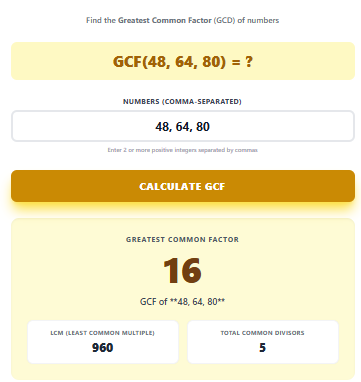
Our calculator shows you each step:
- Input numbers: 48, 64, 80
- Prime factorization:
- 48 = 2⁴ × 3
- 64 = 2⁶
- 80 = 2⁴ × 5
- Common prime factors: 2
- Minimum power: 2⁴ = 16
- GCF: 16
- All common divisors: 1, 2, 4, 8, 16
- Simplification: 48/16=3, 64/16=4, 80/16=5 → 16(3, 4, 5)
GCF vs LCM: What's the Difference?
| GCF | LCM | |
|---|---|---|
| What it finds | Largest common divisor | Smallest common multiple |
| Question | "What divides into both?" | "What do both divide into?" |
| For 12 and 18 | 6 | 36 |
| Size relative to inputs | ≤ both numbers | ≥ both numbers |
| Use case | Simplifying fractions | Adding fractions |
The Key Relationship
For any two numbers: GCF(a, b) × LCM(a, b) = a × b
Check with 12 and 18:
- GCF(12,18) = 6
- LCM(12,18) = 36
- 6 × 36 = 216
- 12 × 18 = 216 ✓
Special Cases
When One Number Divides the Other
If a divides b, then GCF(a, b) = a
- GCF(3, 12) = 3
- GCF(5, 25) = 5
When Numbers Are Coprime (GCF = 1)
Numbers that share no common factors:
- GCF(3, 4) = 1
- GCF(5, 7) = 1
- GCF(8, 9) = 1
- GCF(11, 13, 17) = 1
GCF of 1 and Any Number
GCF(1, n) = 1
GCF of Zero
By convention, GCF(a, 0) = |a|. Our calculator uses positive integers only.
How to Use Our GCF Calculator
Our calculator is designed to be simple and educational.
Step 1: Enter Your Numbers
Type numbers separated by commas. Example: 48, 64, 80
Step 2: Click Calculate
Or just wait—the calculator updates automatically.
Step 3: Read Your Results
You'll see:
- The GCF: The greatest common factor
- LCM: For comparison
- Total common divisors: Count of all divisors of the GCF
- Step-by-step: Prime factorization and Euclidean algorithm
- Practical application: Simplified form
What It Handles
| Input | Example | Works? |
|---|---|---|
| Two numbers | 48, 64 | ✓ |
| Three numbers | 48, 64, 80 | ✓ |
| Four or more | 12, 18, 24, 36 | ✓ |
| Large numbers | 144, 180, 240 | ✓ |
| Coprime numbers | 7, 11, 13 | ✓ (GCF=1) |
| Invalid input | 48, abc, 64 | ⚠️ Ignores non-numbers |
| Negative numbers | -48, 64 | ⚠️ Uses absolute values |
The Euclidean Algorithm Explained
This is one of the oldest algorithms in mathematics (from Euclid's Elements, ~300 BCE).
How It Works
For GCF(a, b) with a > b:
- Divide a by b, get remainder r
- Replace a with b, b with r
- Repeat until remainder = 0
- The last non-zero remainder is the GCF
Example: GCF(48, 64)
Step 1: 64 = 48 × 1 + 16
Step 2: 48 = 16 × 3 + 0

GCF = 16
Example: GCF(1071, 462)
Step 1: 1071 = 462 × 2 + 147
Step 2: 462 = 147 × 3 + 21
Step 3: 147 = 21 × 7 + 0

GCF = 21
Our calculator shows these steps when you enter exactly 2 numbers.
Common Mistakes (I've Made Every Single One)
Mistake 1: Confusing GCF with LCM
Wrong: GCF(12, 18) = 36 Right: GCF(12, 18) = 6
Remember: GCF is smaller than or equal to both numbers.
Mistake 2: Forgetting 1 is Always a Factor
GCF is never 0. If numbers are coprime, GCF = 1.
Mistake 3: Not Checking All Numbers
For three numbers, a common factor must divide all of them:
- GCF(6, 10, 15) = 1 (no common factor > 1)
- 2 divides 6 and 10 but not 15 → not in GCF
Mistake 4: Taking Maximum Power Instead of Minimum
Wrong: GCF(12, 18) = 2² × 3² = 36 (that's LCM!) Right: GCF = 2¹ × 3¹ = 6 (take minimum power)
Mistake 5: Forgetting to Check All Prime Factors
Numbers may share a prime in different powers:
- GCF(8, 12): 8=2³, 12=2²×3 → common: 2²=4
Quick Reference: GCF Formulas
Definition
GCF(a, b) = largest integer dividing both a and b
Euclidean Algorithm
GCF(a, b) = GCF(b, a mod b)
Prime Factorization Method
GCF = product of common primes raised to minimum powers
Properties
| Property | Example |
|---|---|
| GCF(a, b) ≤ min(a, b) | GCF(12,18)=6 ≤ 12 |
| GCF(a, a) = a | GCF(7,7)=7 |
| GCF(a, 1) = 1 | GCF(5,1)=1 |
| GCF(a, b) = GCF(b, a) | GCF(12,18)=GCF(18,12) |
| GCF(a, b, c) = GCF(GCF(a, b), c) | Can compute pairwise |
Common GCF Pairs (Memorize These)
| Numbers | GCF | Numbers | GCF |
|---|---|---|---|
| 4, 6 | 2 | 12, 18 | 6 |
| 6, 8 | 2 | 12, 24 | 12 |
| 8, 12 | 4 | 15, 20 | 5 |
| 9, 12 | 3 | 16, 24 | 8 |
| 10, 15 | 5 | 18, 24 | 6 |
| 12, 16 | 4 | 24, 36 | 12 |
Teaching GCF (or Learning Yourself)
Start with Simple Pairs
Practice where one number divides the other:
- GCF(2, 4) = 2
- GCF(3, 9) = 3
- GCF(5, 25) = 5
Use Real Objects
- 12 apples and 18 oranges → largest equal groups = 6
- 48 tiles and 64 tiles → largest square tile = 16×16
Visualize with Factor Trees
Draw factor trees for each number, then circle common factors.
Practice with Coprime Pairs
GCF(3, 4) = 1 GCF(5, 6) = 1 GCF(7, 8) = 1
Then Try Harder Ones
GCF(12, 18) = 6 GCF(24, 36) = 12 GCF(48, 60, 72) = 12
Frequently Asked Questions
What's the difference between GCF and GCD?
Nothing! GCF (Greatest Common Factor) and GCD (Greatest Common Divisor) mean exactly the same thing.
Can GCF be 0?
No. GCF is defined as a positive integer. For positive inputs, GCF ≥ 1.
What's GCF of 0 and 5?
By definition, GCF(0, n) = |n|. But our calculator expects positive integers.
How do I find GCF of fractions?
GCF of fractions = GCF(numerators) / LCM(denominators). But usually you just need GCF of whole numbers.
Why does Euclidean algorithm work?
Because any common divisor of a and b also divides their remainder. So GCF(a, b) = GCF(b, a mod b).
How does your calculator handle large numbers?
It uses JavaScript numbers (up to ~1.8×10³⁰⁸) and formats large results with scientific notation.
What if numbers are coprime?
The calculator will show GCF = 1 and label them as coprime.
Why do I need all common divisors?
Sometimes you need a common divisor that's not the greatest—like splitting into smaller equal groups.
Your Turn: Start Calculating
GCF used to confuse me. Now it's a tool I use for simplifying fractions, factoring, and everyday grouping problems. The key is understanding it's just "the largest number that divides all my numbers evenly."
Here's your practice plan:
- Start with simple pairs: GCF(4, 6), GCF(12, 18), GCF(15, 25)
- Move to three numbers: GCF(12, 18, 24), GCF(16, 24, 32)
- Try coprime pairs: GCF(7, 11), GCF(8, 9, 25)
- Practice simplifying fractions: 48/64, 36/48, 72/120
- Experiment with our calculator: Try different combinations
- Read the steps: Understand prime factorization and Euclidean algorithm
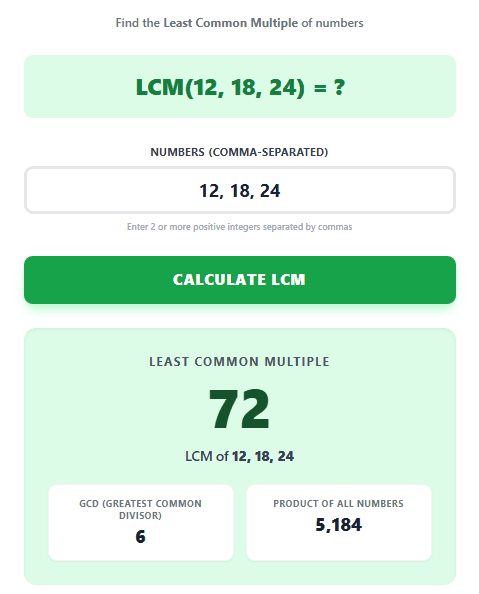
Ready to start? Open up our GCF Calculator and try it yourself. Type in 48, 64 then 12, 18, 24 then something like 48, 64, 80.
You'll get the hang of it faster than you think.
Have questions? Stuck on a particular GCF? Drop a comment below or reach out. I've been where you are, and I'm happy to help.
— The Solvezi Team
Disclaimer: This calculator is for educational purposes. While we aim for accuracy, always double-check critical calculations independently.