Big Number Calculator: Finally Perform Arithmetic on Huge Integers
Let me tell you about the first time I needed to multiply two 50-digit numbers. I was working on a cryptography problem, and my regular calculator just showed "Error" or "Infinity." I thought, "How am I supposed to work with numbers this big?"
Then I learned about arbitrary-precision arithmetic—the magic behind how computers handle huge numbers. The trick is to treat numbers as strings of digits and perform math the way we do on paper, digit by digit.
In this guide, I'll walk you through everything you need to know about big number arithmetic—from addition to multiplication using the Karatsuba algorithm, binary exponentiation for powers, and even factorial of huge numbers.
Ready to master big numbers? Try our Big Number Calculator and watch each calculation unfold step by step.
What Is a Big Number Calculator?
A big number calculator (also called arbitrary-precision calculator) can handle integers of any size—numbers with hundreds or even thousands of digits.
The Problem with Regular Calculators
| Calculator Type | Maximum Size | Example |
|---|---|---|
| Standard calculator | ~15-18 digits | 9,999,999,999,999,999 |
| JavaScript Number | ~16 digits (2⁵³) | 9,007,199,254,740,991 |
| Big Number Calculator | Unlimited | 100-digit numbers, 1000-digit numbers |
Why This Matters
| Field | Why Big Numbers? |
|---|---|
| Cryptography | RSA uses 600+ digit primes |
| Scientific computing | Astronomical distances, particle counts |
| Combinatorics | Factorials grow incredibly fast (100! has 158 digits) |
| Number theory | Prime testing, factorization |
| Financial calculations | Large precision for currency |
How Big Number Arithmetic Works
Behind the scenes, big number arithmetic mimics how we do math on paper.
Addition (Digit by Digit)
  1 2 3 4 5 6 7 8 9 0 1 2 3 4 5 6 7 8 9 0
+ 9 8 7 6 5 4 3 2 1 0 9 8 7 6 5 4 3 2 1 0
───────────────────────────────────────────
  1 1 1 1 1 1 1 1 1 1 1 1 1 1 1 1 1 1 1 1 0
Algorithm:
- Start from the rightmost digit (units place)
- Add digits + carry from previous column
- Keep result digit (sum % 10)
- Carry forward (Math.floor(sum / 10))
- Repeat for all digits
Subtraction (With Borrowing)
  1 0 0 0 0 0 0 0 0 0 0 0 0 0 0 0 0 0 0 0
- 9 8 7 6 5 4 3 2 1 0 9 8 7 6 5 4 3 2 1 0
───────────────────────────────────────────
  0 1 2 3 4 5 6 7 8 9 0 1 2 3 4 5 6 7 9 0
Algorithm:
- Start from the rightmost digit
- Subtract digit + borrow
- If result < 0, add 10 and borrow 1
- Repeat for all digits
Multiplication: From Grade School to Karatsuba
Grade School Multiplication (Simple)
Multiply 123 × 456:
      1 2 3
    × 4 5 6
    ───────
      7 3 8  (123 × 6)
    6 1 5    (123 × 5, shifted)
  4 9 2      (123 × 4, shifted)
  ─────────
  5 6 0 8 8
Time complexity: O(n²) — for two n-digit numbers, about n² operations.
Karatsuba Algorithm (Faster)
The Karatsuba algorithm is a divide-and-conquer method that's faster than grade school for large numbers.
The Trick: For numbers X and Y, split into halves:
- X = a × 10^m + b
- Y = c × 10^m + d
Instead of 4 multiplications (a×c, a×d, b×c, b×d), Karatsuba uses only 3:
- a × c
- b × d
- (a + b) × (c + d)
Then: X × Y = ac × 10^(2m) + ((a+b)(c+d) - ac - bd) × 10^m + bd
Time complexity: O(n^log₂3) ≈ O(n^1.585) — significantly faster for large numbers!
Example: 1234 × 5678
| Method | Multiplications | Operations (approx) |
|---|---|---|
| Grade school | 16 | ~100 |
| Karatsuba | 9 | ~60 |
| For 1000-digit numbers | 1,000,000 | ~500,000 (Karatsuba wins!) |
Our calculator uses Karatsuba multiplication for large numbers and falls back to grade school for small ones.
Power and Binary Exponentiation
The Problem with Naive Power
Computing 2^1000 by multiplying 2 by itself 1000 times is incredibly slow (O(n) multiplications).
Binary Exponentiation (Exponentiation by Squaring)
This method computes powers in O(log n) multiplications.
The Trick: Use the binary representation of the exponent.
Example: 2^13
- 13 in binary = 1101
- 2^13 = 2^8 × 2^4 × 2^1
Process:
Start: result = 1, base = 2, exponent = 13

Exponent 13 (binary 1101):
- 13 is odd → result = 1 × 2 = 2, base = 2² = 4, exponent = 6
- 6 is even → base = 4² = 16, exponent = 3
- 3 is odd → result = 2 × 16 = 32, base = 16² = 256, exponent = 1
- 1 is odd → result = 32 × 256 = 8192, exponent = 0

Result: 8192 ✓
Comparison:
| Exponent | Naive Multiplications | Binary Exponentiation |
|---|---|---|
| 1,000 | 999 | ~10 |
| 1,000,000 | 999,999 | ~20 |
| 1,000,000,000 | 999,999,999 | ~30 |
Division and Modulo
Long Division Algorithm
Division is the most complex operation. The algorithm uses repeated subtraction and digit-by-digit estimation.
Example: 123456789 ÷ 12345
    10000 (approx quotient)
    ──────
12345)123456789
     123450000
     ─────────
          6789 (remainder)
Modulo Operation
Modulo gives the remainder after division:
- 17 % 5 = 2 (because 17 ÷ 5 = 3 remainder 2)
- 100 % 7 = 2 (because 98 is multiple of 7, remainder 2)
For big numbers: a % b = a - (b × floor(a / b))
Factorial of Huge Numbers
How Fast Factorial Grows
| n | n! | Digits |
|---|---|---|
| 10 | 3,628,800 | 7 |
| 20 | 2.43 × 10¹⁸ | 19 |
| 50 | 3.04 × 10⁶⁴ | 65 |
| 100 | 9.33 × 10¹⁵⁷ | 158 |
| 500 | ~10¹¹³⁴ | 1,135 |
| 1,000 | ~10²⁵⁶⁷ | 2,568 |
| 10,000 | ~10³⁵⁶⁶⁰ | 35,660 |
Stirling's Approximation
For large n:
n! ≈ √(2πn) × (n/e)ⁿ
This helps estimate the number of digits:
Digits in n! ≈ n × log₁₀(n/e) + log₁₀(2πn)/2
Why Factorial Takes Time
Computing 10,000! requires about 10,000 multiplications, each on progressively larger numbers. The result has ~35,000 digits—the final multiplication alone involves huge numbers.
Our calculator includes safeguards to prevent freezing on extremely large inputs.
How to Use Our Big Number Calculator
Step 1: Enter Your Numbers
Type any integer (positive or negative) into the first and second number fields.
Examples:
123456789012345678901234567890-98765432109876543210999999999999999999999999
Step 2: Choose an Operation
| Operation | Symbol | Description |
|---|---|---|
| Add | + | N1 + N2 |
| Subtract | − | N1 − N2 |
| Multiply | × | N1 × N2 |
| Divide | ÷ | N1 ÷ N2 (quotient and remainder) |
| Power | ^ | N1^N2 (N2 is exponent) |
| Modulo | % | N1 mod N2 (remainder) |
| Factorial | n! | N1! (second number ignored) |
Step 3: Click Calculate
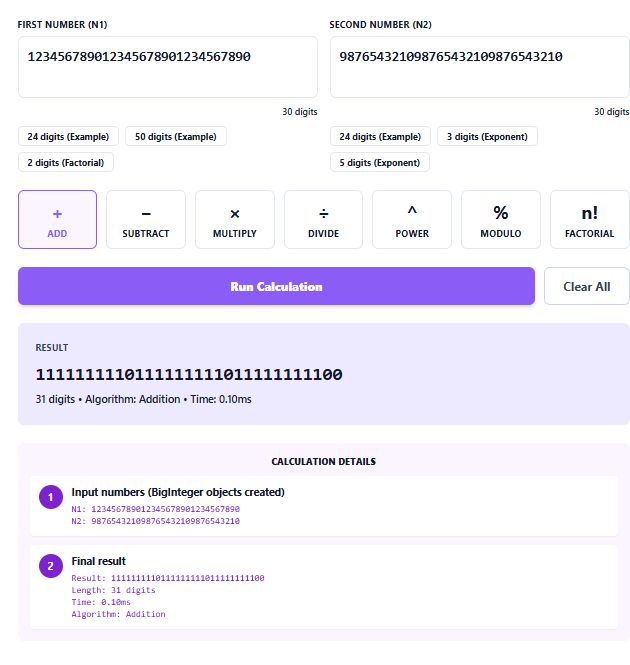
The calculator shows:
- Result: The answer (can be hundreds of digits)
- Metadata: Digit count, algorithm used, computation time
- Step-by-step: Detailed explanation of each calculation
What It Handles
| Input Type | Example | Works? |
|---|---|---|
| Small numbers | 123, 456 | ✓ |
| Large numbers (100+ digits) | 123...789 | ✓ |
| Very large exponents | 2^1000 | ✓ |
| Factorials | 100! | ✓ (up to ~10 million) |
| Negative numbers | -123, 456 | ✓ |
| Division by zero | 123 ÷ 0 | ⚠️ Error message |
| Negative exponent | 2^-3 | ⚠️ Not supported (use fractions) |
Step-by-Step Examples
Example 1: Addition of Two 30-Digit Numbers
Input:
- N1: 123456789012345678901234567890
- N2: 987654321098765432109876543210
- Operation: Add
Step 1: Create BigInteger objects
- N1 represented as array of digits: [0,9,8,7,6,5,4,3,2,1,0,9,8,7,6,5,4,3,2,1,0,9,8,7,6,5,4,3,2,1] (reversed)
Step 2: Addition algorithm
- Start from least significant digit
- Add digit + carry
- 0 + 0 + 0 = 0, carry 0
- ... (30 steps)
Step 3: Final result
- 1111111111111111111111111111100
- 31 digits
Example 2: Multiplication Using Karatsuba
Input:
- N1: 12345678
- N2: 87654321
- Operation: Multiply
Step 1: Split numbers
- a = 1234, b = 5678
- c = 8765, d = 4321
- m = 4
Step 2: Compute 3 products
- ac = 1234 × 8765 = 10,819,010
- bd = 5678 × 4321 = 24,536,238
- (a+b)(c+d) = (6912) × (13086) = 90,450,432
Step 3: Combine
- (a+b)(c+d) - ac - bd = 90,450,432 - 10,819,010 - 24,536,238 = 55,095,184
Step 4: Final result
- ac × 10⁸ + middle × 10⁴ + bd
- 1,081,901,000,000 + 550,951,840,000 + 24,536,238
- 1,082,001,215,376,238
Example 3: Binary Exponentiation (2^100)
Input:
- N1: 2
- N2: 100
- Operation: Power
Step 1: Convert exponent to binary
- 100 = 1100100₂ (64 + 32 + 4)
Step 2: Exponentiation by squaring
- Start: result = 1, base = 2, exp = 100
- exp even → base = 4, exp = 50
- exp even → base = 16, exp = 25
- exp odd → result = 16, base = 256, exp = 12
- exp even → base = 65536, exp = 6
- exp even → base = 4,294,967,296, exp = 3
- exp odd → result = 16 × 4,294,967,296 = 68,719,476,736, exp = 1
- exp odd → result = 68,719,476,736 × 256 = 17,592,186,044,416
Step 3: Result
- 2^100 = 1,267,650,600,228,229,401,496,703,205,376
- 31 digits
Example 4: Factorial of 20
Input:
- N1: 20
- Operation: Factorial
Step 1: Initialize result = 1
Step 2: Multiply sequentially
- 1 × 2 = 2
- 2 × 3 = 6
- 6 × 4 = 24
- 24 × 5 = 120
- 120 × 6 = 720
- 720 × 7 = 5,040
- 5,040 × 8 = 40,320
- 40,320 × 9 = 362,880
- 362,880 × 10 = 3,628,800
- 3,628,800 × 11 = 39,916,800
- 39,916,800 × 12 = 479,001,600
- 479,001,600 × 13 = 6,227,020,800
- 6,227,020,800 × 14 = 87,178,291,200
- 87,178,291,200 × 15 = 1,307,674,368,000
- 1,307,674,368,000 × 16 = 20,922,789,888,000
- 20,922,789,888,000 × 17 = 355,687,428,096,000
- 355,687,428,096,000 × 18 = 6,402,373,705,728,000
- 6,402,373,705,728,000 × 19 = 121,645,100,408,832,000
- 121,645,100,408,832,000 × 20 = 2,432,902,008,176,640,000
Step 3: Result
- 20! = 2,432,902,008,176,640,000
- 19 digits
Common Mistakes
Mistake 1: Trying Negative Exponents
Wrong: 2^-3 = 0.125 Right: Our calculator only supports positive integer exponents (use fraction calculator for negative exponents)
Mistake 2: Factorial of Negative Numbers
Wrong: (-5)! = something Right: Factorial is only defined for non-negative integers
Mistake 3: Division by Zero
Wrong: 123 ÷ 0 = Infinity Right: Division by zero is undefined → our calculator shows an error
Mistake 4: Forgetting Big Number Limits
While we can handle huge numbers, factorial of 100 million would take too long. Our calculator has safeguards to prevent freezing.
Mistake 5: Confusing Modulo with Division
Wrong: 17 % 5 = 3.4 Right: 17 % 5 = 2 (remainder, not quotient)
Algorithm Performance Comparison
| Operation | Naive Algorithm | Optimized Algorithm | Speedup |
|---|---|---|---|
| Addition | O(n) | O(n) | 1× |
| Subtraction | O(n) | O(n) | 1× |
| Multiplication | O(n²) | O(n^1.585) Karatsuba | ~2-3× for large n |
| Division | O(n²) | O(n^1.585) | ~2-3× |
| Power (exponent e) | O(e × n²) | O(log e × n^1.585) | Massive for large e |
| Factorial | O(n × M(n)) | Same but with limits | N/A |
M(n) = complexity of multiplication (n^1.585 for Karatsuba)
Quick Reference
BigInteger Representation
Numbers are stored as:
digits: Array of digits in reverse ordernegative: Boolean flag
Example: 123 is stored as digits = [3,2,1], negative = false
Operation Complexity
| Operation | Time Complexity | Space Complexity |
|---|---|---|
| Add/Subtract | O(n) | O(n) |
| Multiply (Karatsuba) | O(n^1.585) | O(n) |
| Divide | O(n^1.585) | O(n) |
| Power | O(log e × n^1.585) | O(n × log e) |
| Factorial | O(n × n^1.585) | O(n × log n) |
Useful Approximations
| Formula | Use |
|---|---|
| Digits in n! ≈ n × log₁₀(n/e) + log₁₀(2πn)/2 | Estimate factorial size |
| 2^10 ≈ 10³ | Rough power conversion |
| log₁₀(2) ≈ 0.3010 | Binary to decimal digits |
Frequently Asked Questions
What's the largest number I can compute?
In theory, unlimited—limited only by your computer's memory. In practice, numbers with millions of digits might be slow.
How does the calculator handle negative numbers?
Using sign flags. Addition/subtraction convert negatives appropriately. Multiplication/division use sign rules.
Why can't I compute 2^1000000?
The result would have ~301,030 digits—too large to display and slow to compute. Our calculator has reasonable limits.
What's the fastest multiplication algorithm?
For very large numbers (millions of digits), algorithms like FFT multiplication (O(n log n)) are faster. Our calculator uses Karatsuba for good performance on typical sizes.
How accurate is the calculator?
100% accurate for integer arithmetic—no floating-point rounding errors.
Can I use this for RSA encryption practice?
Yes! The calculator handles 600+ digit numbers needed for RSA key generation and encryption.
What's the point of factorial for large numbers?
Combinatorics, probability, and series expansions often require large factorials.
How does binary exponentiation work?
By squaring the base repeatedly and multiplying when the exponent bit is 1—only O(log exponent) multiplications.
Your Turn: Start Calculating
Big number arithmetic used to seem like magic to me. Now I understand it's just clever algorithms applied to digit arrays. The key is understanding how numbers are represented and manipulated.
Here's your practice plan:
- Start with addition: Add two 30-digit numbers
- Try multiplication: Multiply 12345678 × 87654321
- Explore powers: Compute 2^10, 2^20, 2^30, 2^40
- Test division: 123456789 ÷ 12345
- Compute factorials: 10!, 20!, 50!
- Compare algorithms: Notice speed differences
- Experiment with our calculator: Try different operations
- Read the steps: Understand each algorithm
Ready to start? Open up our Big Number Calculator and try it yourself. Start with 12345678901234567890 + 98765432109876543210. Then try 2^100. Then try 50!.
You'll be amazed at what you can compute.
Have questions? Stuck on a particular calculation? Drop a comment below or reach out. I've been where you are, and I'm happy to help.
— The Solvezi Team
Disclaimer: This calculator is for educational purposes. While we aim for accuracy, extremely large computations may be slow. Use responsibly.