Magic Number Checker: Finally Discover All Properties of Any Number
Let me tell you about the first time I realized numbers have multiple personalities. I typed 7 into a calculator and discovered it's prime, odd, and someone's favorite number. Then I tried 28—perfect number, even, and the days in a lunar month. Then 153—Armstrong number, odd, and a biblical reference.
Every number has a story. Some are prime, some are composite. Some are Fibonacci, some are Armstrong. Some are palindromes, some are perfect squares. And when you look at all these properties together, each number becomes unique.
In this guide, I'll walk you through all the properties our Magic Number Checker reveals—from primality to Fibonacci status, from Armstrong numbers to palindromes, and everything in between.
Ready to discover the magic in numbers? Try our Magic Number Checker and uncover the hidden properties of any number.
What Does the Magic Number Checker Do?
Our Magic Number Checker analyzes any number (positive, negative, integer, or decimal) and reveals its mathematical properties:
| Property | Description |
|---|---|
| Prime/Composite | Is the number prime or composite? |
| Even/Odd | Is the number even or odd? |
| Perfect Square | Is the number a perfect square? |
| Fibonacci Number | Is the number in the Fibonacci sequence? |
| Armstrong Number | Does it equal sum of its digits raised to power? |
| Palindrome | Does it read the same forward and backward? |
| Factor Count | How many divisors does it have? |
| Binary Representation | What is it in base 2? |
| Special Facts | Unique trivia about famous numbers |
Property 1: Prime vs Composite
What It Means
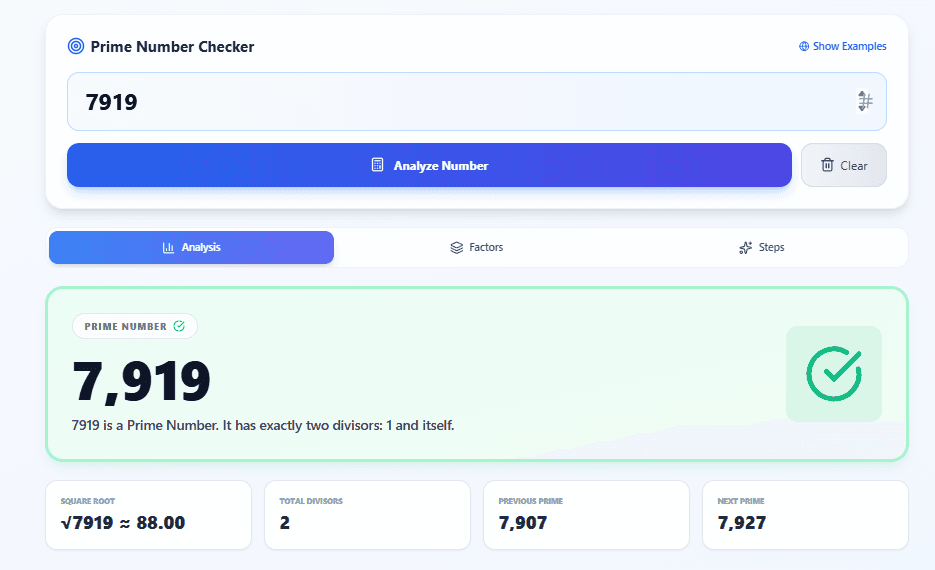
- Prime number: Has exactly two factors (1 and itself)
- Composite number: Has more than two factors
- Neither: 0 and 1 are neither prime nor composite
Examples
| Number | Classification | Factors |
|---|---|---|
| 2 | Prime | 1, 2 |
| 3 | Prime | 1, 3 |
| 4 | Composite | 1, 2, 4 |
| 7 | Prime | 1, 7 |
| 12 | Composite | 1, 2, 3, 4, 6, 12 |
| 1 | Neither | 1 |
| 0 | Neither | Infinite |
How to Check
Our calculator uses trial division up to √n, optimized with 6k ± 1 pattern.
Property 2: Even vs Odd
What It Means
- Even number: Divisible by 2 (ends in 0, 2, 4, 6, 8)
- Odd number: Not divisible by 2 (ends in 1, 3, 5, 7, 9)
Examples
| Number | Even/Odd | Last Digit |
|---|---|---|
| 2 | Even | 2 |
| 3 | Odd | 3 |
| 10 | Even | 0 |
| 17 | Odd | 7 |
| 100 | Even | 0 |
Property 3: Perfect Square
What It Means
A number that can be expressed as k² for some integer k.
Examples
| Number | Square Root | Perfect Square? |
|---|---|---|
| 1 | 1 | ✓ |
| 4 | 2 | ✓ |
| 9 | 3 | ✓ |
| 16 | 4 | ✓ |
| 25 | 5 | ✓ |
| 2 | ~1.414 | ✗ |
| 10 | ~3.162 | ✗ |
How to Check
Calculate √n and check if it's an integer: Math.sqrt(n) % 1 === 0
Property 4: Fibonacci Number
What It Means
A number that appears in the Fibonacci sequence: 0, 1, 1, 2, 3, 5, 8, 13, 21, 34, 55, 89, 144...
The Formula
A number n is Fibonacci if and only if 5n² + 4 or 5n² - 4 is a perfect square.
Examples
| Number | In Fibonacci? | Position |
|---|---|---|
| 0 | ✓ | F₀ |
| 1 | ✓ | F₁, F₂ |
| 2 | ✓ | F₃ |
| 3 | ✓ | F₄ |
| 5 | ✓ | F₅ |
| 8 | ✓ | F₆ |
| 13 | ✓ | F₇ |
| 21 | ✓ | F₈ |
| 34 | ✓ | F₉ |
| 4 | ✗ | - |
| 6 | ✗ | - |
| 7 | ✗ | - |
First 20 Fibonacci Numbers
0, 1, 1, 2, 3, 5, 8, 13, 21, 34, 55, 89, 144, 233, 377, 610, 987, 1597, 2584, 4181
Property 5: Armstrong Number (Narcissistic)
What It Means
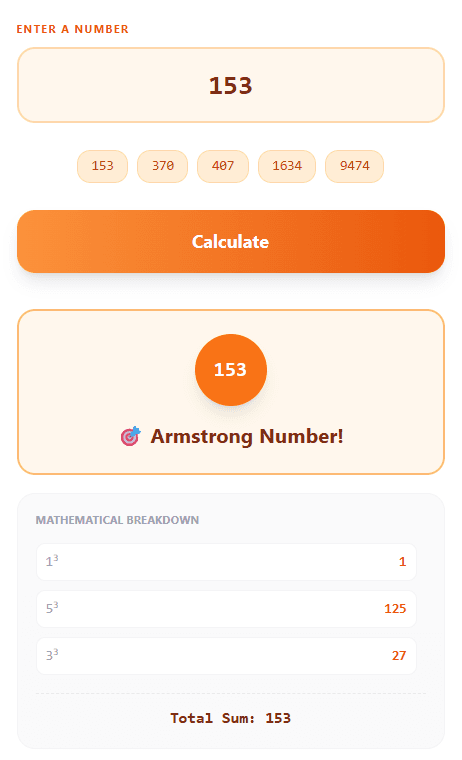
A number that equals the sum of its own digits each raised to the power of the number of digits.
Formula
For an n-digit number with digits d₁d₂...dₙ: d₁ⁿ + d₂ⁿ + ... + dₙⁿ = number
Examples
| Number | Digits | Power | Calculation | Armstrong? |
|---|---|---|---|---|
| 1 | 1 | 1¹ | 1 | ✓ |
| 2 | 1 | 2¹ | 2 | ✓ |
| 3 | 1 | 3¹ | 3 | ✓ |
| 4 | 1 | 4¹ | 4 | ✓ |
| 5 | 1 | 5¹ | 5 | ✓ |
| 6 | 1 | 6¹ | 6 | ✓ |
| 7 | 1 | 7¹ | 7 | ✓ |
| 8 | 1 | 8¹ | 8 | ✓ |
| 9 | 1 | 9¹ | 9 | ✓ |
| 153 | 3 | 1³+5³+3³ | 1+125+27=153 | ✓ |
| 370 | 3 | 3³+7³+0³ | 27+343+0=370 | ✓ |
| 371 | 3 | 3³+7³+1³ | 27+343+1=371 | ✓ |
| 407 | 3 | 4³+0³+7³ | 64+0+343=407 | ✓ |
| 1634 | 4 | 1⁴+6⁴+3⁴+4⁴ | 1+1296+81+256=1634 | ✓ |
| 10 | 2 | 1²+0² | 1+0=1≠10 | ✗ |
Property 6: Palindrome
What It Means
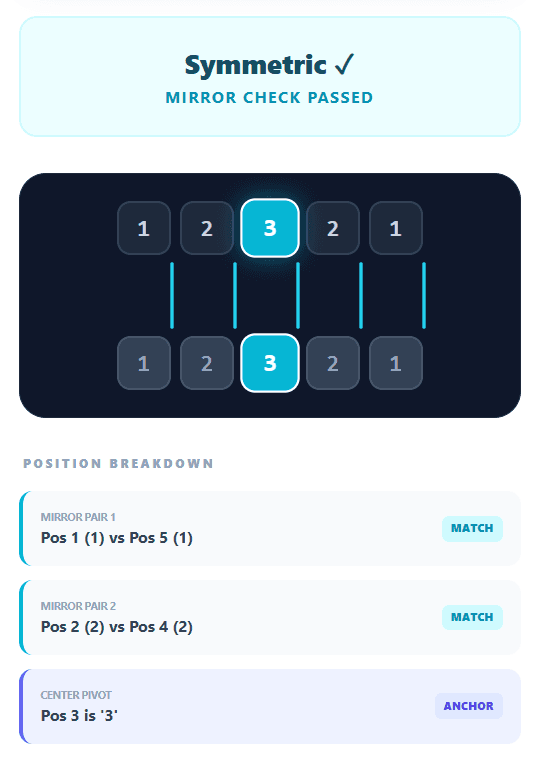
A number that reads the same forward and backward.
Examples
| Number | Forward | Backward | Palindrome? |
|---|---|---|---|
| 121 | 121 | 121 | ✓ |
| 12321 | 12321 | 12321 | ✓ |
| 8008 | 8008 | 8008 | ✓ |
| 11 | 11 | 11 | ✓ |
| 5 | 5 | 5 | ✓ |
| 123 | 123 | 321 | ✗ |
| 1234 | 1234 | 4321 | ✗ |
Property 7: Factor Count
What It Means
The number of positive integers that divide n evenly.
Examples
| Number | Factors | Factor Count |
|---|---|---|
| 1 | 1 | 1 |
| 2 | 1, 2 | 2 |
| 3 | 1, 3 | 2 |
| 4 | 1, 2, 4 | 3 |
| 6 | 1, 2, 3, 6 | 4 |
| 12 | 1, 2, 3, 4, 6, 12 | 6 |
| 28 | 1, 2, 4, 7, 14, 28 | 6 |
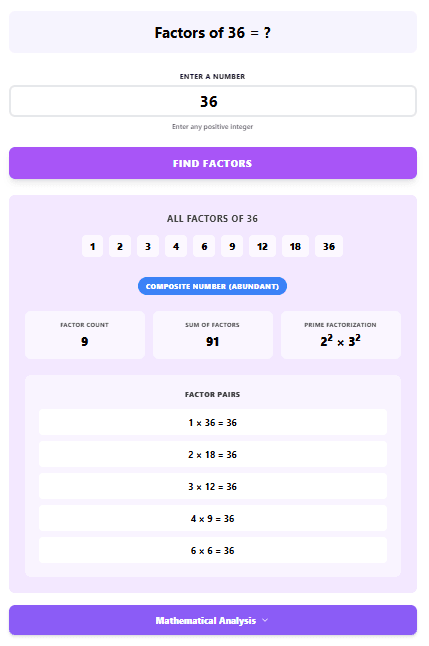
| 36 | 1, 2, 3, 4, 6, 9, 12, 18, 36 | 9 |
Factor Count Formula (Tau Function)
If n = p₁ᵉ¹ × p₂ᵉ² × ... × pₖᵉᵏ Then τ(n) = (e₁+1)(e₂+1)...(eₖ+1)
Example: 36 = 2² × 3² → τ(36) = (2+1)(2+1) = 3×3 = 9 ✓
Property 8: Binary Representation
What It Means
The number expressed in base 2 (using only digits 0 and 1).
Examples
| Decimal | Binary |
|---|---|
| 0 | 0 |
| 1 | 1 |
| 2 | 10 |
| 3 | 11 |
| 4 | 100 |
| 5 | 101 |
| 6 | 110 |
| 7 | 111 |
| 8 | 1000 |
| 9 | 1001 |
| 10 | 1010 |
| 16 | 10000 |
| 31 | 11111 |
| 32 | 100000 |
Step-by-Step Examples
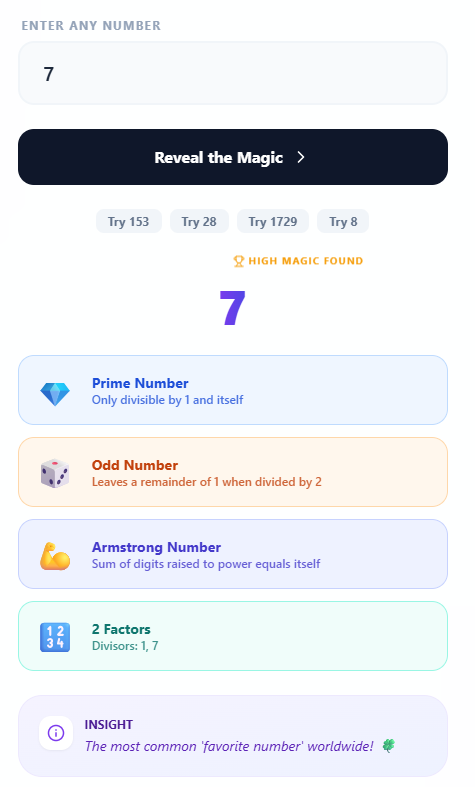
Example 1: The Number 7
Properties revealed:
- ✅ Prime: Only divisible by 1 and 7
- ✅ Odd: Last digit 7 is odd
- ❌ Perfect Square: √7 ≈ 2.645, not integer
- ❌ Fibonacci: 7 is not in Fibonacci sequence (5, 8 are neighbors)
- ❌ Armstrong: 7¹ = 7 ✓ (all 1-digit are Armstrong)
- ✅ Palindrome: Single digit
- Factor Count: 2 factors (1, 7)
- Binary: 111₂
- Special Fact: The most common "favorite number" worldwide!
Example 2: The Number 28
Properties revealed:
- ❌ Prime: Composite (factors: 1, 2, 4, 7, 14, 28)
- ✅ Even: Ends with 8
- ❌ Perfect Square: √28 ≈ 5.29, not integer
- ❌ Fibonacci: 21 and 34 are Fibonacci neighbors
- ❌ Armstrong: 2³+8³=8+512=520 ≠ 28
- ✅ Palindrome: 28 reversed is 82 ≠ 28 → Wait, 28 is NOT palindrome
- Factor Count: 6 factors
- Binary: 11100₂
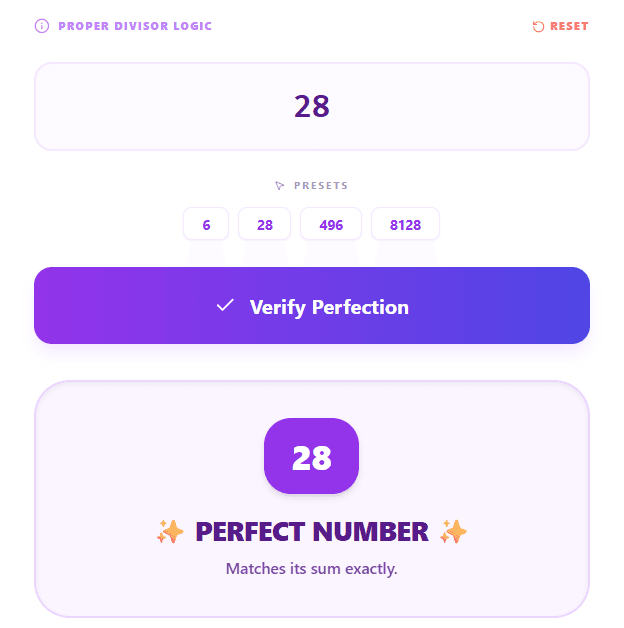
- Special Fact: Perfect number! 1+2+4+7+14 = 28
Example 3: The Number 153
Properties revealed:
- ❌ Prime: Composite (153 = 9 × 17)
- ✅ Odd: Ends with 3
- ❌ Perfect Square: √153 ≈ 12.37
- ❌ Fibonacci: 144 and 233 are neighbors
- ✅ Armstrong: 1³+5³+3³ = 1+125+27 = 153 ✓
- ❌ Palindrome: 351 ≠ 153
- Factor Count: 6 factors (1, 3, 9, 17, 51, 153)
- Binary: 10011001₂
- Special Fact: Appears in the Bible (153 fish)
Example 4: The Number 1729
Properties revealed:
- ❌ Prime: Composite (1729 = 7 × 13 × 19)
- ✅ Odd: Ends with 9
- ❌ Perfect Square: √1729 ≈ 41.58
- ❌ Fibonacci: 1597 and 2584 are neighbors
- ❌ Armstrong: 1⁴+7⁴+2⁴+9⁴ = 1+2401+16+6561 = 8979 ≠ 1729
- ❌ Palindrome: 9271 ≠ 1729
- Factor Count: 8 factors
- Binary: 11011000001₂
- Special Fact: The Hardy-Ramanujan taxicab number (smallest sum of two cubes in two ways: 1³+12³ = 9³+10³)
Example 5: The Number 0
Properties revealed:
- ❌ Prime: Neither prime nor composite
- ✅ Even: Divisible by 2
- ✅ Perfect Square: 0² = 0
- ✅ Fibonacci: F₀ = 0
- ❌ Armstrong: 0¹ = 0 ✓ (1-digit Armstrong)
- ✅ Palindrome: Single digit
- Factor Count: Infinite factors (every number divides 0)
- Binary: 0₂
- Special Fact: Neither positive nor negative—the origin point.
How to Use Our Magic Number Checker
Step 1: Enter Any Number
Type any number (positive, negative, integer, or decimal). Examples: 7, 28, 153, 1729, -5, 3.14
Step 2: Click Reveal the Magic
The calculator analyzes the number across all properties.
Step 3: Explore the Results
You'll see cards for each property:
- Prime/Composite: With explanation
- Even/Odd: With visual indicator
- Perfect Square: With square root if applicable
- Fibonacci: With sequence context
- Armstrong: With digit power calculation
- Palindrome: With reversal check
- Factor Count: With divisor list (capped at 50)
- Binary: Base-2 representation
- Special Fact: Unique trivia about famous numbers
Quick Try Buttons
Test famous numbers:
- 153 (Armstrong, biblical)
- 28 (Perfect number)
- 1729 (Taxicab number)
- 8 (Fibonacci, power of 2)
Famous Numbers and Their Magic
| Number | Why Famous | Properties |
|---|---|---|
| 0 | Origin | Even, perfect square, Fibonacci |
| 1 | Unity | Odd, perfect square, Fibonacci |
| 7 | Lucky | Prime, odd, most common favorite |
| 12 | Dozen | Composite, even, abundant |
| 28 | Perfect | Perfect number, even |
| 153 | Biblical | Armstrong, odd |
| 1729 | Taxicab | Composite, odd, Hardy-Ramanujan |
| 314159 | Pi digits | Composite, odd |
Common Mistakes
Mistake 1: Thinking 1 Is Prime
Wrong: "1 is prime because it has no factors" Right: 1 has only one factor (itself), not two. Primes need exactly two distinct factors.
Mistake 2: Thinking 0 Is Prime
Wrong: "0 is prime" Right: 0 is neither prime nor composite.
Mistake 3: Confusing Armstrong with Automorphic
Wrong: "5 is Armstrong because 5² ends with 5" Right: That's automorphic. Armstrong is sum of digit powers.
Mistake 4: Thinking All Odd Numbers Are Prime
Wrong: "9 is odd, so it must be prime" Right: 9 = 3 × 3, composite.
Mistake 5: Forgetting Negative Numbers
Negative numbers can be even/odd, but primality and Fibonacci are defined for positives.
Quick Reference
Number Classifications
| Property | Check | Example |
|---|---|---|
| Prime | Only 2 factors | 7 |
| Composite | >2 factors | 12 |
| Even | Divisible by 2 | 28 |
| Odd | Not divisible by 2 | 153 |
| Perfect Square | √n integer | 16 |
| Fibonacci | 5n²±4 perfect square | 8 |
| Armstrong | Sum(digitⁿ) = n | 153 |
| Palindrome | Reads same backward | 121 |
Famous Number Facts
| Number | Fact |
|---|---|
| 7 | Most common favorite number |
| 42 | Answer to Life, Universe, Everything |
| 1729 | Hardy-Ramanujan taxicab number |
| 0 | Origin point |
| 1 | Unit |
| 153 | Appears in Bible |
Frequently Asked Questions
What numbers can I check?
Any number—positive, negative, integer, or decimal.
What's the most magical number?
That's subjective! 1729 has the taxicab property, 153 is Armstrong, 28 is perfect.
Why does 1 have only 1 factor?
Because 1 × 1 = 1, so it only has one distinct factor.
Is 0 a Fibonacci number?
Yes, F₀ = 0.
What's an Armstrong number?
A number that equals the sum of its digits each raised to the power of digit count.
What's a perfect number?
A number that equals the sum of its proper divisors (all divisors except itself).
What's the Hardy-Ramanujan number?
1729, the smallest number expressible as sum of two cubes in two different ways.
How does your calculator handle large numbers?
It uses efficient algorithms, but very large numbers may take longer.
Can decimals be prime?
No. Primality is defined only for integers > 1.
What's the most properties a number can have?
Numbers like 1 and 0 have many properties. 1 is odd, perfect square, Fibonacci, palindrome, and more!
Your Turn: Start Exploring
Every number has a story. Some are prime, some are perfect. Some are Armstrong, some are Fibonacci. Some are palindromes, some are squares. Our Magic Number Checker reveals them all.
Here's your practice plan:
- Start with 7: Prime, odd, favorite number
- Try 28: Perfect number, even
- Test 153: Armstrong number, odd
- Explore 1729: Taxicab number, composite
- Check 0: Origin, even, square, Fibonacci
- Try 1: Unity, odd, square, Fibonacci
- Use quick try buttons: 153, 28, 1729, 8
- Enter your own: Birth year, lucky number, any number!
Ready to start? Open up our Magic Number Checker and try it yourself. Start with 7, then 28, then 153, then 1729.
You'll discover the magic in numbers faster than you think.
Have questions? Stuck on a particular number? Drop a comment below or reach out. I've been where you are, and I'm happy to help.
— The Solvezi Team
Disclaimer: This calculator is for educational purposes. For very large numbers, some calculations may be limited.