Quadratic Formula Calculator: Finally Understand Those ax² + bx + c Equations
Let me take you back to my sophomore year of algebra. My teacher wrote "x² + 5x + 6 = 0" on the board and said, "Solve it." I stared at that equation like it was written in ancient Greek. Factoring? Completing the square? Quadratic formula? I had no idea where to start.
Fast forward a few years (and many late-night study sessions), I realized something: quadratic equations aren't complicated. They just have a formula that looks scary until you break it down. And once you understand that formula, you can solve any quadratic equation in about 30 seconds.
In this guide, I'll walk you through everything you need to know about quadratic equations—from the basics to complex roots—and show you how our quadratic formula calculator can help you not just get answers, but actually understand what's happening.
Ready to conquer quadratics? Try our Quadratic Formula Calculator and watch each solution unfold step by step.
What Is a Quadratic Equation?
A quadratic equation is any equation that can be written in the form:
ax² + bx + c = 0
Where:
- a, b, and c are numbers (coefficients)
- a cannot be zero (if a = 0, it becomes linear)
- x is the variable we're solving for
Examples of Quadratics
- x² + 5x + 6 = 0 (a = 1, b = 5, c = 6)
- 2x² - 3x + 1 = 0 (a = 2, b = -3, c = 1)
- x² - 4 = 0 (a = 1, b = 0, c = -4)
- -x² + 2x = 0 (a = -1, b = 2, c = 0)
See the pattern? Always an x² term, an x term (maybe), and a constant (maybe).
Why "Quadratic"?
"Quadratic" comes from "quadratus," Latin for square. Because the highest power is x²—x squared. Makes sense, right?
The Quadratic Formula: Your New Best Friend
Here's the formula that solves EVERY quadratic equation:
x = [-b ± √(b² - 4ac)] / (2a)
I know. It looks terrifying. But let me break it down piece by piece.
Parts of the Formula
- -b: Negative of the coefficient b
- ±: Plus or minus (gives two solutions)
- √(b² - 4ac): Square root of the discriminant
- 2a: Two times coefficient a
What Makes It Work
This formula comes from "completing the square"—a method developed by ancient mathematicians. But you don't need to know that history. You just need to know how to plug numbers in.
The Discriminant: The Crystal Ball of Quadratics
Before you even solve, the discriminant tells you what kind of solutions you'll get.
Discriminant (Δ) = b² - 4ac
Three Cases
| Discriminant | What It Means | Solutions |
|---|---|---|
| Δ > 0 | Positive | Two different real numbers |
| Δ = 0 | Zero | One repeated real number |
| Δ < 0 | Negative | Two complex numbers (imaginary) |
Example 1: Δ > 0
x² + 5x + 6 = 0
- a = 1, b = 5, c = 6
- Δ = 5² - 4(1)(6) = 25 - 24 = 1 (positive)
- Solutions: x = -2 and x = -3
Example 2: Δ = 0
x² + 4x + 4 = 0
- a = 1, b = 4, c = 4
- Δ = 16 - 16 = 0
- Solution: x = -2 (repeated)
Example 3: Δ < 0
x² + 2x + 5 = 0
- a = 1, b = 2, c = 5
- Δ = 4 - 20 = -16 (negative)
- Solutions: x = -1 ± 2i (complex)
Step-by-Step: How to Use the Quadratic Formula
Let me show you exactly how to solve a quadratic using the formula. I'll use x² + 5x + 6 = 0.
Step 1: Identify a, b, c
x² + 5x + 6 = 0
- a = 1 (coefficient of x²)
- b = 5 (coefficient of x)
- c = 6 (constant term)
Step 2: Write the Formula
x = [-b ± √(b² - 4ac)] / (2a)
Step 3: Plug in the Numbers
x = [-5 ± √(5² - 4×1×6)] / (2×1)
Step 4: Calculate Inside the Square Root
5² = 25 4×1×6 = 24 b² - 4ac = 25 - 24 = 1
Step 5: Take Square Root
√1 = 1
Step 6: Handle the ±
With +: x = (-5 + 1) / 2 = -4 / 2 = -2 With -: x = (-5 - 1) / 2 = -6 / 2 = -3
Step 7: Write Solutions
x = -2 or x = -3
That's it. Every quadratic follows this exact process.
Real-World Applications (Where Quadratics Actually Show Up)
You might be thinking, "When will I ever use this?" Here's where quadratics appear in real life.
Projectile Motion
Throw a ball in the air? That's a quadratic. The height h(t) = -16t² + v₀t + h₀. When does it hit the ground? Solve h(t) = 0.
Example: A ball thrown upward at 64 ft/s from 80 ft high:
- -16t² + 64t + 80 = 0
- t = 5 seconds (positive solution)
Business and Economics
Maximizing profit often involves quadratics. The profit function P(x) = -ax² + bx + c (a parabola opening downward) has a maximum at the vertex.
Engineering
Bridge designs, satellite dishes, headlight reflectors—all use parabolas (the graph of a quadratic).
Computer Graphics
Parabolic trajectories in games? Quadratic equations.
Physics
Kinematics equations (like d = v₀t + ½at²) are quadratics. Solve for t to find when something lands.
Other Ways to Solve Quadratics
The quadratic formula works for everything, but sometimes other methods are faster.
Factoring (Fastest When It Works)
x² + 5x + 6 = 0
- Find two numbers that multiply to 6 and add to 5: 2 and 3
- (x + 2)(x + 3) = 0
- x = -2 or x = -3
When to use: When a = 1 and b, c are small integers.
Square Root Method
x² = 9
- Take square root: x = ±3
When to use: When equation is x² = number.
Completing the Square
x² + 6x + 5 = 0
- x² + 6x = -5
- Add 9 to both sides: x² + 6x + 9 = 4
- (x + 3)² = 4
- x + 3 = ±2
- x = -1 or x = -5
When to use: When you need to derive the quadratic formula or find vertex.
Quadratic Formula (Always Works)
Use this when:
- Factoring is hard (big numbers)
- a ≠ 1
- b is odd or messy
- You need complex roots
- You want a guaranteed method
Complex Roots: What Happens When Δ < 0
When the discriminant is negative, you get imaginary numbers. Don't panic—this is normal in advanced math and engineering.
Example: x² + 2x + 5 = 0
Step 1: a = 1, b = 2, c = 5 Step 2: Δ = 2² - 4(1)(5) = 4 - 20 = -16 Step 3: √(-16) = √(16 × -1) = 4i (where i² = -1) Step 4: x = [-2 ± 4i] / 2 Step 5: x = -1 ± 2i
So the solutions are -1 + 2i and -1 - 2i.
What Does This Mean?
In the real world, complex roots often indicate oscillation or periodic behavior. In electrical engineering, they represent AC circuits. In control systems, they tell you if a system will oscillate.
How to Use Our Quadratic Formula Calculator
I designed this calculator to show you exactly how the formula works—not just give you answers.
Step 1: Enter Your Coefficients
- a: Coefficient of x² (can't be zero)
- b: Coefficient of x (can be any number)
- c: Constant term (can be any number)
Step 2: Watch It Update
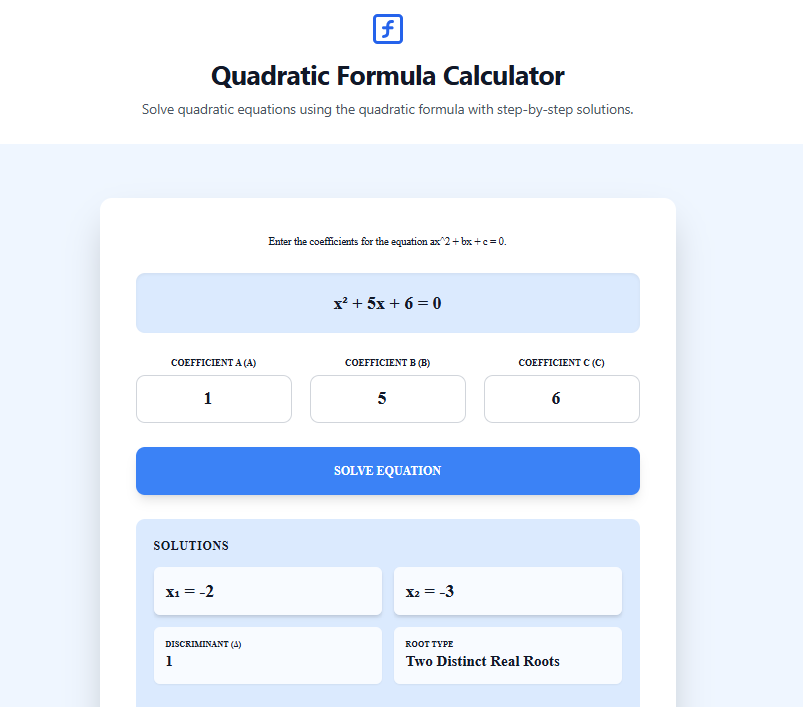
The equation displays as you type. You'll see something like "x² + 5x + 6 = 0" or "2x² - 3x + 1 = 0".
Step 3: Click Solve
Or just wait—the calculator solves automatically as you type.
Step 4: Read Your Results
You'll see:
- Solutions: x₁ and x₂ (or one repeated root, or complex roots)
- Discriminant: Δ = b² - 4ac
- Root Type: Real distinct, real repeated, or complex conjugates
- Step-by-Step: Every calculation explained
Step 5: Study the Steps
This is where the learning happens. Each step shows:
- What formula is being used
- How numbers are substituted
- Intermediate calculations
- Final simplification
Understanding the Step-by-Step Solutions
Let me walk you through what the calculator shows for x² + 5x + 6 = 0.
Step 1: The Quadratic Formula
x = (-b ± √(b² - 4ac)) / (2a)
This reminds you what you're using.
Step 2: Substitute Coefficients
a = 1, b = 5, c = 6
Step 3: Calculate the Discriminant
Δ = b² - 4ac
Δ = 5² - 4(1)(6)
Δ = 25 - 24
Δ = 1
Step 4: Since Δ > 0, Two Real Roots
√Δ = √1 = 1
Step 5: Calculate x₁ (plus sign)
x₁ = (-5 + 1) / (2×1)
x₁ = (-4) / 2
x₁ = -2
Step 6: Calculate x₂ (minus sign)
x₂ = (-5 - 1) / 2
x₂ = -6 / 2
x₂ = -3
Step 7: Solutions
x = -2 or x = -3
For complex roots, it shows the imaginary unit i and properly formats complex numbers like "-1 + 2i" and "-1 - 2i".
Common Mistakes (I've Made All of These)
Mistake 1: Forgetting a ≠ 0
If a = 0, it's not quadratic. Our calculator will warn you.
Mistake 2: Sign Errors
x² - 5x + 6 = 0 means a = 1, b = -5, c = 6. Don't forget that minus sign on b!
Mistake 3: Forgetting the ±
You need both solutions. The ± gives you two.
Mistake 4: Messing Up the Order
x = (-b ± √Δ) / (2a), not (b ± √Δ) / (2a) or (-b ± √Δ) / a.
Mistake 5: Incorrect Square Roots
√4 = 2, not ±2 (the ± comes from the formula, not the square root itself).
Mistake 6: Complex Numbers Fear
When Δ < 0, √Δ = √(-n) = √n × i. It's okay—our calculator handles this automatically.
Mistake 7: Not Simplifying
x = (-4 ± 2) / 2 should simplify to x = -2 ± 1.
Teaching Quadratics (or Learning Yourself)
If you're learning quadratics (or helping someone learn), here's what works.
Start with Simple Factoring
x² + 5x + 6 = 0 → (x + 2)(x + 3) = 0 → x = -2, -3
This builds intuition.
Introduce the Discriminant First
Before solving, just calculate Δ. Practice identifying whether you'll get real or complex roots.
Memorize the Formula
Say it out loud: "x equals negative b plus or minus the square root of b squared minus 4ac, all over 2a."
Practice with Integer Solutions
Start with equations that give nice answers: x² - 5x + 6 = 0 (roots 2 and 3), x² - 9 = 0 (roots ±3).
Then Move to Fractions
2x² - 5x + 2 = 0 → roots 2 and 0.5
Finally, Complex Roots
x² + 2x + 5 = 0 → roots -1 ± 2i
Use the Calculator as a Learning Tool
- Guess first: Try to solve by hand
- Check with calculator: See if you're right
- Study the steps: Where did you go wrong?
- Adjust and try again
Quadratic Formula vs. Factoring vs. Completing Square
| Method | When to Use | Speed | Reliability |
|---|---|---|---|
| Factoring | Small integers, a=1 | Fastest | Only works when factorable |
| Square Root | x² = number | Very fast | Limited use |
| Completing Square | Need vertex form | Moderate | Always works |
| Quadratic Formula | Any quadratic | Moderate | Always works |
My advice: Learn all methods. Use factoring when it's easy (saves time). Use the quadratic formula when factoring is messy (guaranteed solution).
Frequently Asked Questions
What if a = 0?
Then it's not quadratic—it's linear. Solve bx + c = 0 → x = -c/b.
Why are there two solutions?
Because quadratic equations are degree 2, so they have two roots (by the Fundamental Theorem of Algebra). Sometimes they're the same (repeated), sometimes they're complex.
What does "complex conjugate" mean?
When roots are complex (a + bi and a - bi), they're conjugates. The imaginary parts are opposites.
Can the quadratic formula give decimal answers?
Yes! Our calculator shows decimals for irrational roots like (1 ± √5)/2.
How accurate is the calculator?
It uses JavaScript's math functions, accurate to about 15 decimal places. Results are rounded for display.
Why does it sometimes show "x₁ = -2" and "x₂ = -3" instead of "x = -2 or -3"?
It's standard math notation. x₁ and x₂ just mean "first solution" and "second solution."
What's the discriminant used for besides root type?
It tells you about the graph:
- Δ > 0: Parabola crosses x-axis at two points
- Δ = 0: Parabola touches x-axis at one point (vertex)
- Δ < 0: Parabola never touches x-axis (above or below)
How do I get complex roots on the calculator?
Just enter coefficients that give Δ < 0. For example, a=1, b=2, c=5. The calculator automatically shows complex solutions.
Quick Reference: Quadratic Formula Cheat Sheet
Formula
x = [-b ± √(b² - 4ac)] / (2a)
Discriminant
Δ = b² - 4ac
Root Types
- Δ > 0: Two real roots
- Δ = 0: One real root (repeated)
- Δ < 0: Two complex roots (a ± bi)
Vertex (x-coordinate of parabola's peak)
h = -b / (2a)
Standard Form
ax² + bx + c = 0
Examples to Practice
| Equation | a | b | c | Δ | Roots |
|---|---|---|---|---|---|
| x² + 5x + 6 = 0 | 1 | 5 | 6 | 1 | -2, -3 |
| x² - 9 = 0 | 1 | 0 | -9 | 36 | 3, -3 |
| x² + 4x + 4 = 0 | 1 | 4 | 4 | 0 | -2 (double) |
| 2x² - 4x + 2 = 0 | 2 | -4 | 2 | 0 | 1 (double) |
| x² + 2x + 5 = 0 | 1 | 2 | 5 | -16 | -1 ± 2i |
| 2x² + 3x - 2 = 0 | 2 | 3 | -2 | 25 | 0.5, -2 |
Your Turn: Start Solving
Quadratic equations used to terrify me. Now they're one of the first things I reach for when solving real-world problems.
The key is practice. The more you use the formula, the more natural it becomes.
Here's your practice plan:
- Start with simple ones: x² + 5x + 6 = 0, x² - 4 = 0
- Try factoring first: See if you can do it without the formula
- Then use the formula: Verify your answers
- Read the steps: Understand each calculation
- Try messy ones: 3x² + 7x - 5 = 0 (roots are ugly, but the formula works)
- Try complex roots: x² + 2x + 2 = 0
Ready to start? Open up our Quadratic Formula Calculator and try it yourself. Type in x² + 5x + 6 = 0 (a=1, b=5, c=6) and watch the step-by-step solution unfold.
You'll have this down in no time.
Have questions? Get stuck on a particular equation? Drop a comment below or reach out. I've been where you are, and I'm happy to help.
— The Solvezi Team
Disclaimer: This calculator is for educational purposes. While we aim for accuracy, always double-check critical calculations independently. For complex engineering or scientific applications, verify results with additional tools.